

Ticketing & Revenue Management: when bad timing gets expensive
Plummeting prices, empty stadiums, ticketing panic… What if the real problem was timing? At Revbell,...
See more
How the shift from GDS to NDC and “continuous pricing” could transform airline ticket prices: increases, decreases, or just a pricing illusion?
Articles are starting to appear on the topic. “Continuous pricing” would lower airline ticket prices. Really?
For over 10 years, airlines have been trying to break free from the high costs of GDS (Global Distribution System) and migrate to a new format, NDC (New Distribution Capability). The old EDIFACT protocol of GDS is therefore gradually being phased out in favor of internal management of pricing and inventory, with NDC allowing airlines to host their own fares and distribute them more freely.
One of the consequences of this change is simultaneously breaking free from fare classes.
Let’s hear from David Keller :
“Today, in the EDIFACT system, the same airline seat is offered at 26 different fares, depending on when it is booked. (…) Schematically, we can say that these 26 fares correspond to the 26 steps (called ‘classes’) of an ascending staircase.”
Indeed, the many airline fare codes are today grouped into fare classes with a similar level of contribution (also called Yield Classes, Buckets, or booking classes). There aren’t necessarily 26 of them but the number is generally close. The fare gap between these classes is typically between 5% and 15% corresponding to the “stair steps” mentioned earlier.
Bertrand Flory continues the explanation:
“Today, if I book my ticket while it is still in the class where it cost 100, I would pay 120. With NDC, I might pay 102, 104, 112 or even later 120 but at the very last moment, before it goes up to 122 (…). So an NDC ticket price is indeed less than or equal to the EDIFACT price.”
And to drive the point home, Aurélie Duprez from AREKA Consulting states:
“We conducted an audit for a CAC 40 company on its top routes in 2023. In 90% of cases, NDC tickets were lower than or equal to EDIFACT tickets.”
The reality is likely to disappoint many. Certainly, it is possible that part of the GDS distribution costs currently borne by airlines could be passed on to customers tomorrow in the form of lower fares, especially during the launch phase. But the explanation put forward by Bertrand Flory seems somewhat fanciful. He essentially says that in the famous fare staircase, a higher step would be smoothed into a price continuum and result in a fare reduction down to the lower step. The optimist would therefore think that a small increase is actually a decrease.
In other words, if 20 customers are expected at €100 and then 10 more at €120, the author assumes that the first 20 will still pay €100 but the 11th will pay €102 (instead of €120), the 12th €104 (instead of €120) and so on.
However the mechanism could operate differently with small price increases applied to the current step rather than rolling back from the next one. In our example, the first customer might pay €100, the second €101 (instead of €100), the third €102 (instead of €100)… and the 20th €119 (instead of still €100). That is, rather small continuous price increases for everyone rather than a decrease.
Fare management will be handled by the Revenue Management teams. They will use pricing in the way that is most relevant to them. Likely, this will involve a controlled average with as many increases as decreases on regular flights, more increases on peak flights and more decreases on off-peak flights.
Only time will tell, though it will be difficult for an outside observer to assess. Only the airlines will truly know because the number of tickets offered for sale at each fare level is known only to them. Price tracking alone will not be sufficient to get an accurate picture, no matter how frequent it is.
But let’s not dream too much: prices will not automatically drop all the time and for everyone. That is not the goal for those opting for “continuous pricing” and abandoning fare classes.
Overall, prices are generally lower
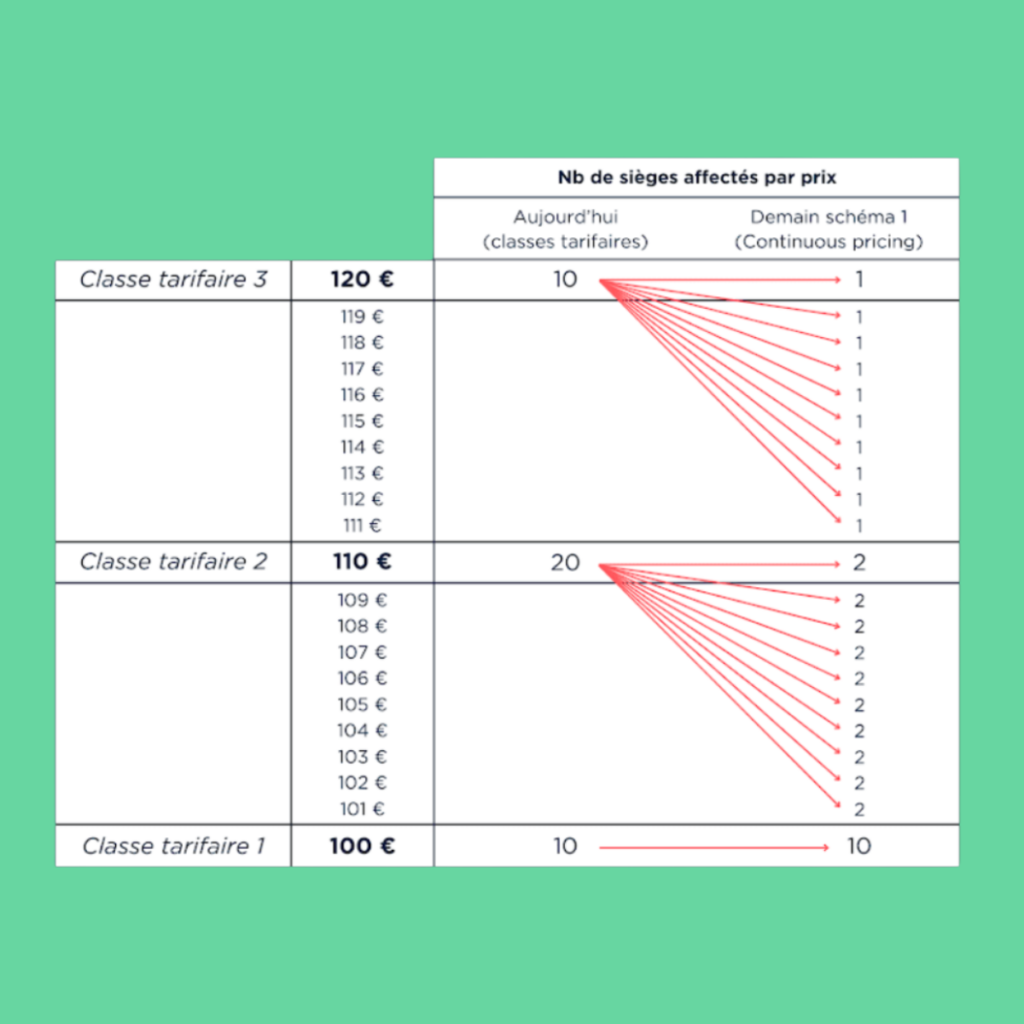
Overall, prices are generally higher
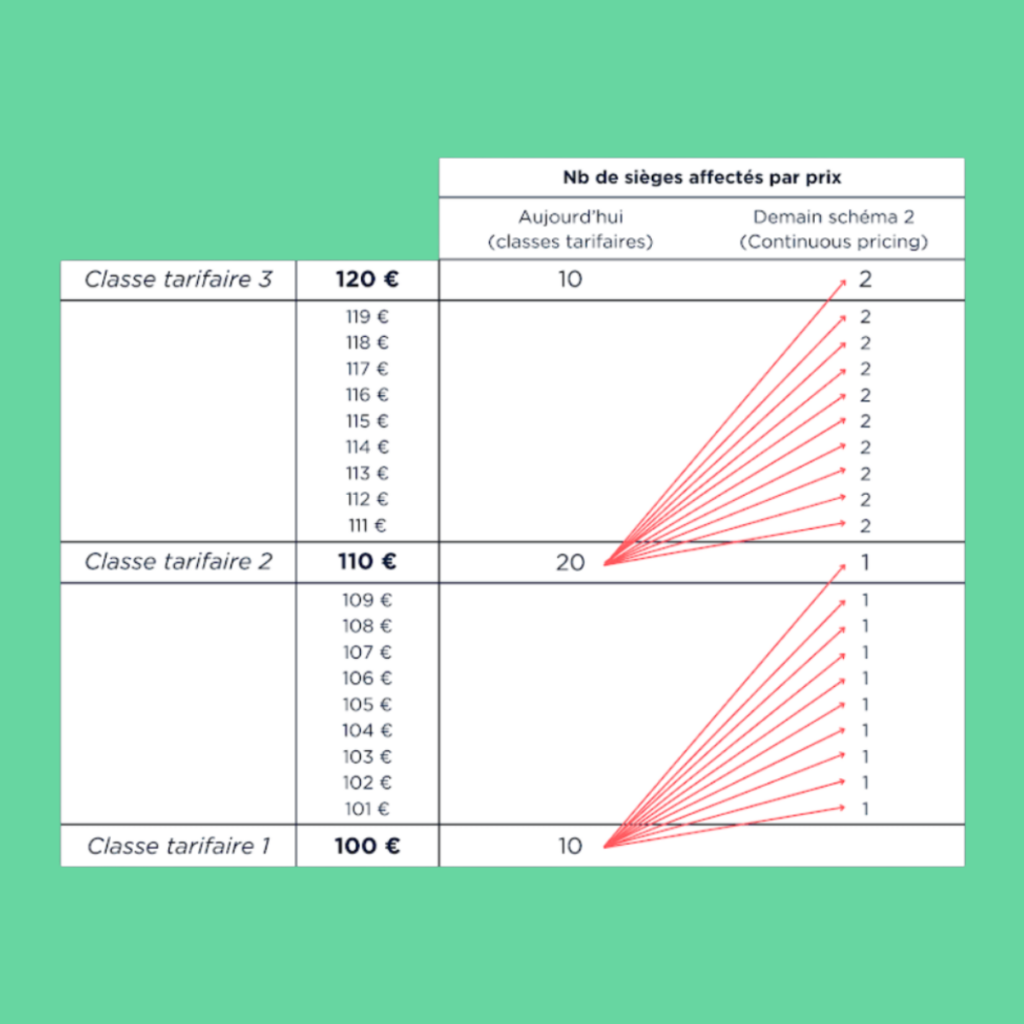
Fermé
It is a mechanism that allows airlines to adjust ticket prices continuously, instead of using fixed fare classes.
Fermé
In some cases, yes. But it depends on the flight, demand, and the Revenue Management strategy. Fare reductions are not automatic.
Fermé
To reduce the high costs of EDIFACT systems and manage their fares more freely through NDC.